Athangudi Tile Design Ideas: Patterns, Colours and Where They Work
Most people pick an Athangudi tile by looking at one piece in a catalogue. Then the floor goes down, the same motif repeats a few hundred times, and it looks nothing like the sample.
That is the real challenge with these handmade tiles. A good Athangudi design is about how the pattern behaves across a whole room, with your furniture, your walls and the light in your home.
This guide covers the main design styles, colour combinations that work, and which patterns suit which rooms. If you are still deciding whether Athangudi is the right material at all, start with our Athangudi vs Terrazzo flooring comparison and come back here for the design side.
For a traditional home, go for floral or kolam-inspired motifs. For a modern home, choose a geometric pattern in two colours. For a quieter look, keep the main floor plain and use an Athangudi border. In a small room, pick a small repeat and avoid strong colour contrast.
Athangudi tile design ideas by pattern
1. Floral and kolam-inspired patterns
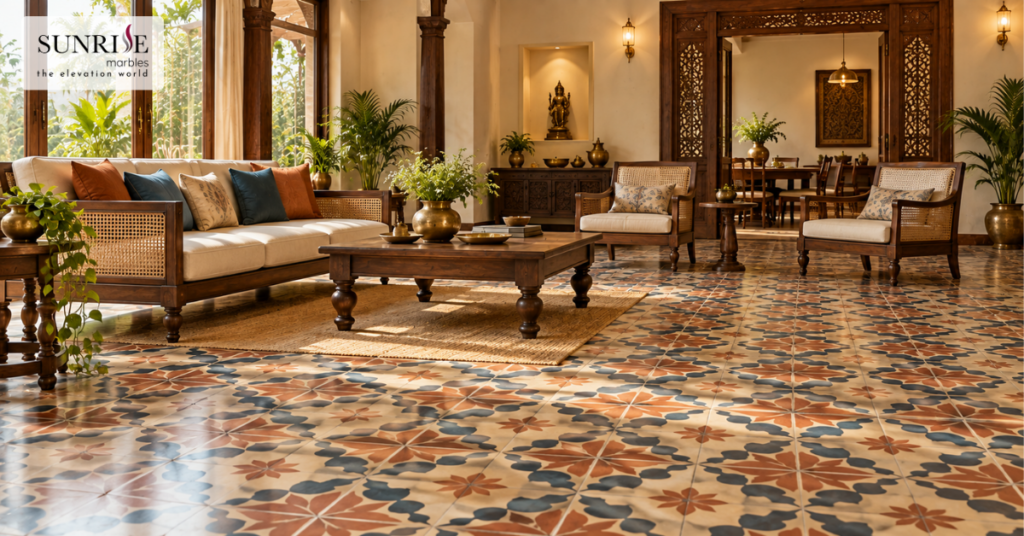
This is the style most people picture when they think of Athangudi. Flowers, leaves and kolam-style lines repeat in a tight grid, usually in reds, greens and cream.
They look best with wood. Teak furniture, a carved door, brass lamps and cane chairs all sit well on a floral floor. Keep the walls plain, because the floor is already doing the talking.
Check the motif size before you commit. A small flower repeated closely gives a rich, almost carpet-like effect. A large single bloom per tile looks bolder and more open.
2. Geometric patterns
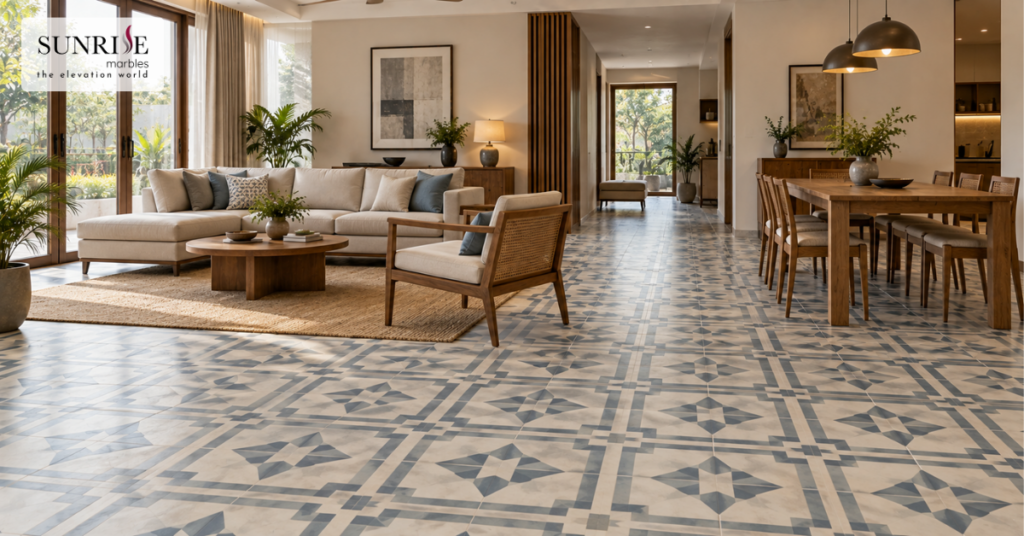
Squares, diamonds, lines and stepped shapes give the floor a cleaner, more structured look. This is the easiest style to use in an apartment or a contemporary villa.
Grey-blue on cream, or black on white, keeps a geometric floor calm. Pair it with neutral sofas and simple lighting and the room feels modern, with just a little craft in the floor.
One warning: geometric patterns show alignment errors more than florals do. A crooked line is obvious. Ask your mason to lay a few tiles dry before fixing anything.
3. Star and medallion patterns
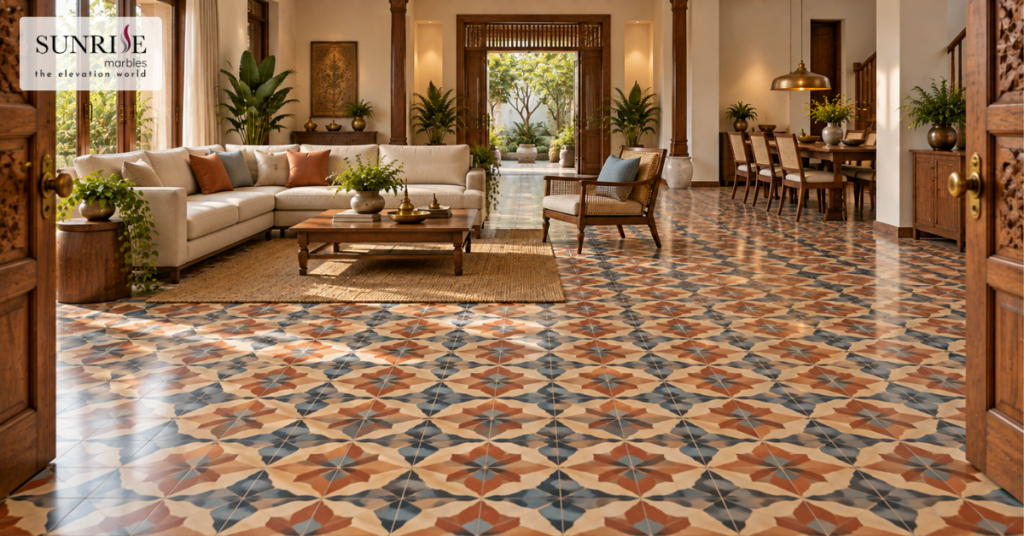
Eight-point stars, rosettes and centred medallions work as a centrepiece. These are the designs that make a floor look planned rather than just tiled.
They suit rooms with a clear centre, such as a square hall, a living room with the seating grouped in the middle, or an entrance lobby you see the moment the door opens. In a long, narrow room they can look awkward, because the eye has no natural centre to land on.
4. Border designs
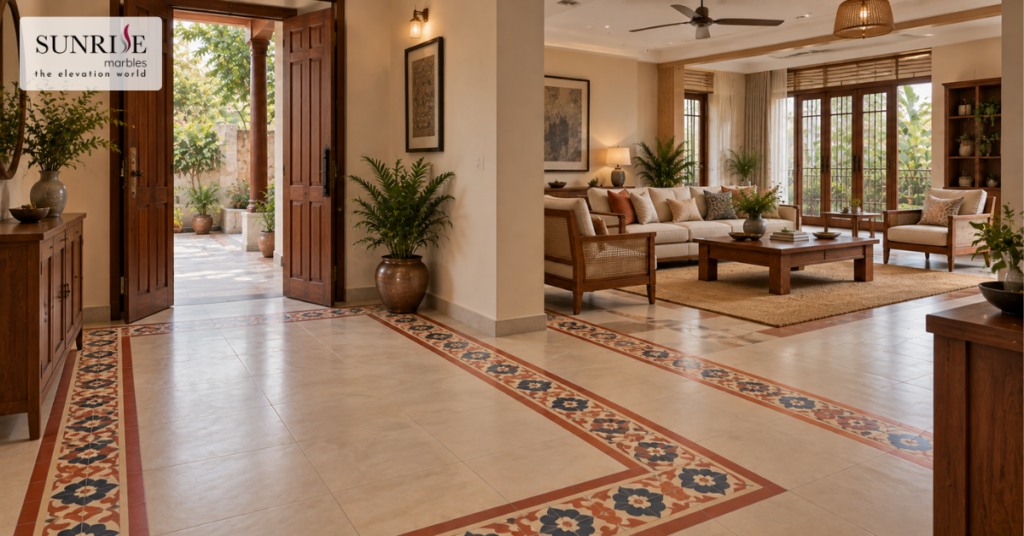
A border lets you use Athangudi without covering the whole floor. Lay plain tiles in the middle and run a patterned band around the edge, or use a border to mark off a seating area or a pooja corner.
It is also the most budget-friendly way to get the look. The border width matters more than people expect. Too thin and it looks like a skirting line. Too wide and it eats into the room. As a starting point, match the width to a whole number of tiles so no piece needs cutting along the length.
5. Multicolour designs
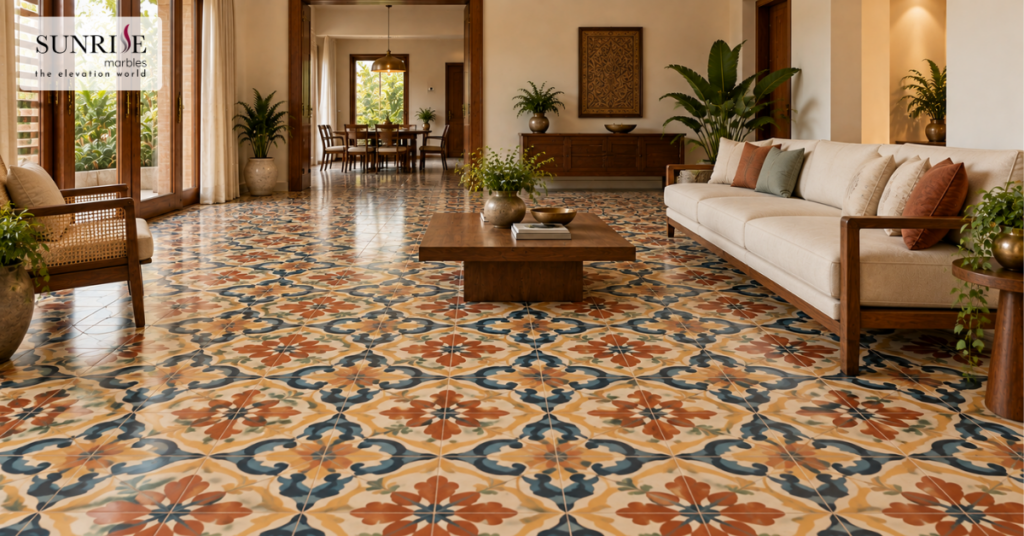
Red oxide, indigo, mustard and cream together make a floor that people notice first. Use this in one room, not five.
Keep everything else quiet: off-white walls, simple furniture, one or two cushions that pick up a colour from the floor. If the sofa is patterned, the rug is patterned and the floor is patterned, none of them wins.
6. Two-colour designs
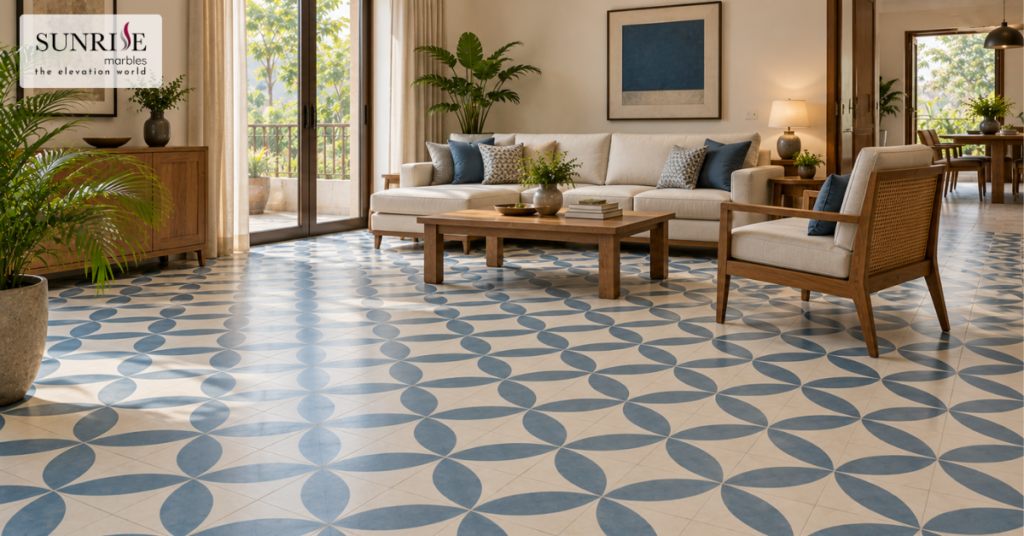
Blue and white is the classic. Terracotta and cream, or black and white, work just as well. With only two colours, even a busy motif stays easy on the eye.
This is the safest choice for small rooms, bedrooms and homes where you are not fully sure about a bold floor.
7. Plain tiles with one accent
If you want the handmade finish without any pattern, plain coloured Athangudi tiles in a soft shade work well. Add a few patterned tiles as an inset at the entrance or in front of the pooja shelf. It is a small change that gets noticed.
Colour combinations and the mood they create
Combination | Feels like | Works well with |
|---|---|---|
Red oxide + cream | Warm, traditional | Teak, brass, white walls |
Blue + white | Fresh, cool | Cane, light wood, sunlit rooms |
Black + white | Crisp, graphic | Modern furniture, metal accents |
Green + cream | Calm, earthy | Indoor plants, natural fibres |
Mustard + indigo + red | Bold, festive | Plain walls, minimal furniture |
Colours shift with light. A tile that looks soft in a shop can look much stronger under a tubelight, and different again in the evening. Always look at samples in the room itself, in daylight and at night.
Not sure which pattern will look right in your room? Send us a photo of the space on WhatsApp at +91 92465 22030 and our team will suggest patterns that suit it. You can also call us on +91 92465 22030.
Which Athangudi design suits which room?
Living room. A floral or medallion pattern as the main floor works if you want a traditional feel. For a modern living room, use a two-colour geometric pattern. Think about where the sofa and centre table will sit, because they will cover a good part of the pattern.
Entrance and foyer. This is where borders and medallions do the most. A patterned entrance gives visitors a first impression, and it is a small area, so the cost stays reasonable.
Verandah and courtyard. Open-sided spaces suit the classic red-and-cream and blue-and-white designs. Since these areas are exposed to weather and foot traffic, ask us which tile and finish is recommended for outdoor use before you order.
Pooja room. Keep the pattern calm and use it around the focal point, not everywhere. A small medallion or a border in front of the shelf is enough. If you are planning the wall as well, our guide on stone murals for pooja rooms shows how to coordinate the two.
Bedroom. Go for a two-colour pattern in soft tones, or a plain tile with a border. Strong multicolour floors can feel busy in a room meant for rest.
Want to see the tiles in person? Visit our showroom in Yousufguda, Hyderabad, and lay out several pieces together before you decide. Call +91 92465 22030 to check availability or book a time.
How to judge a design before you buy
A few checks save you from regret:
- Look at six to eight tiles together, not one. The repeat is what you will live with.
- Check the scale. Large motifs overwhelm small rooms. Small motifs can look fussy in a big hall.
- View it in your lighting. Hold the sample near the window and again under your room lights.
- Expect small variations. Athangudi tiles are handmade, so shades differ slightly from tile to tile. That is part of the charm, but you should see it before the floor is laid.
- Think about furniture. Imagine the sofa, dining table and bed on top of the pattern.
Plan the layout before the first tile goes down
Patterned floors need a plan on paper. Decide where the pattern starts. The centre of the room is the usual choice, so cuts fall evenly at the edges instead of all on one side.
Check how the pattern meets doorways, because a motif cut in half at a door looks accidental. If you are using a border, fix its position first and lay the field tiles inside it afterwards. Confirm the tile size, thickness and recommended application with the supplier, as these differ between products.
If you are also choosing between hand-poured cement tiles and terrazzo, our terrazzo flooring patterns guide covers that design side.
Common mistakes to avoid
- Choosing from a single-tile photo.
- Using a bold multicolour pattern in every room.
- Pairing a busy floor with busy walls and patterned furniture.
- Forgetting that furniture will hide the centre of the pattern.
- Making the border so thin it looks like a mistake.
- Skipping a dry layout before fixing.
Conclusion
The best Athangudi floor is rarely the busiest one. Pick the pattern that suits the room, test it in your own light, and plan the layout before laying. A well-chosen floor can stay the most talked-about part of the house for years.
Ready to choose? Browse our Athangudi and Terrazzo collection, explore other flooring options, or talk to us directly. Call or WhatsApp +91 92465 22030 and we will help you shortlist designs and arrange samples.